What is meta data?
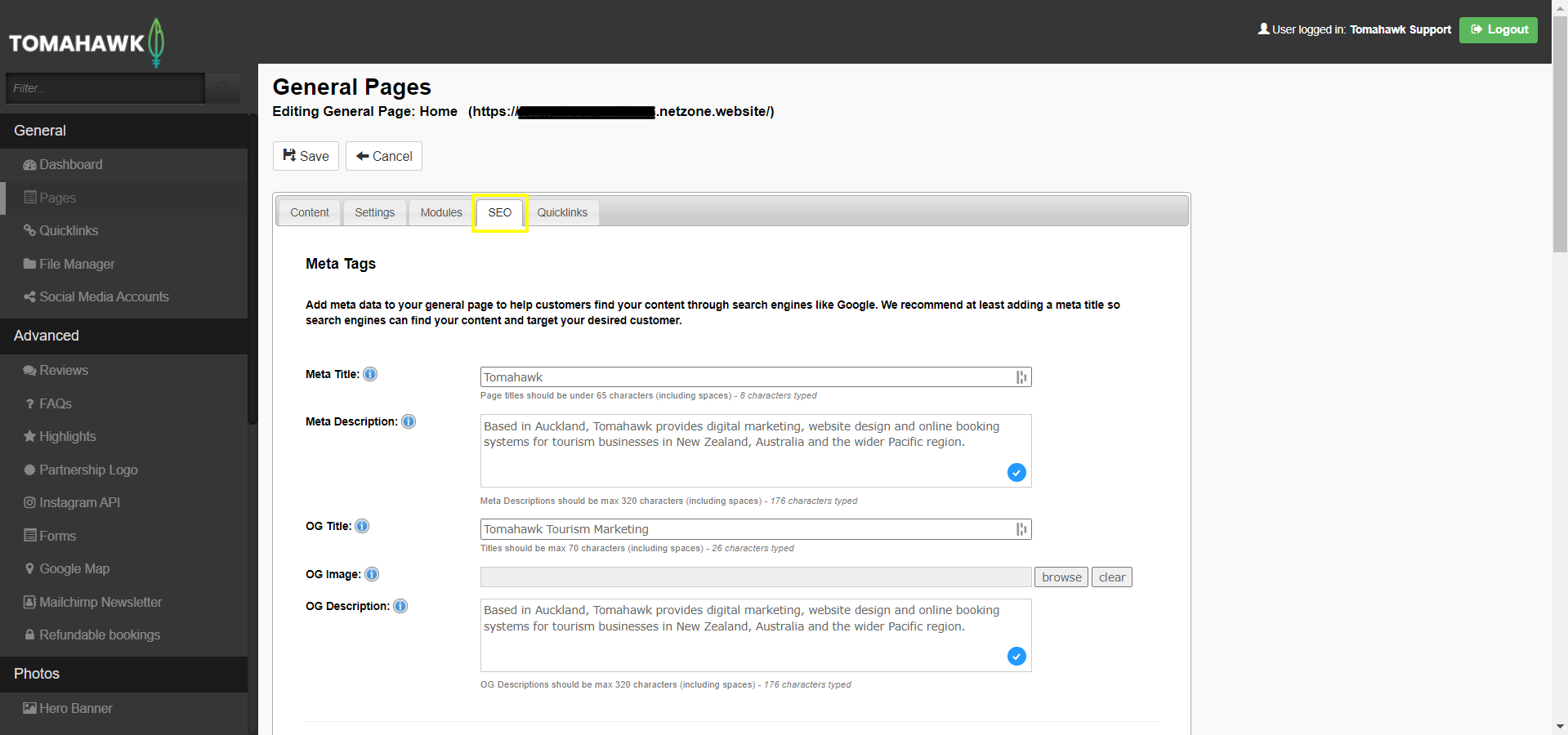
It is important to set these fields within this tab to help support your site appearing in search results on search engines, as well as populate the tabs that display in your browser, and will also display when you share a link to a page.
Example of meta data as a search engine result:
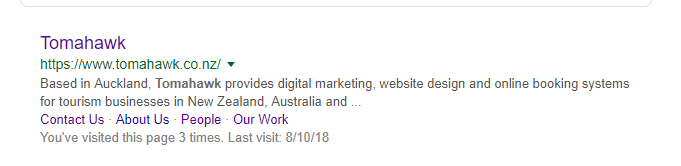
Meta Title: Tomahawk
Meta Description: Based in Auckland, Tomahawk provides digital marketing, website design and online booking systems for tourism businesses in New Zealand, Australia and ...
Example of meta data as a page title:

Meta Title: Tomahawk Marketing, Digital Strategy, Web Design NZ | Tomahawk
Example of meta data when sharing a link (Messenger & LinkedIn):

OG Title: Tomahawk Marketing, Strategy, Web Design & Branding
OG Image: 
Let's first look at the SEO tab you will find within the CMS. You will find this on page types such as General Pages, Blog Pages, Itinerary/Tour Pages, Accommodation Pages, etc.
Within the CMS, navigate to the General menu, then select Pages. Select any page within this menu and select the SEO tab.
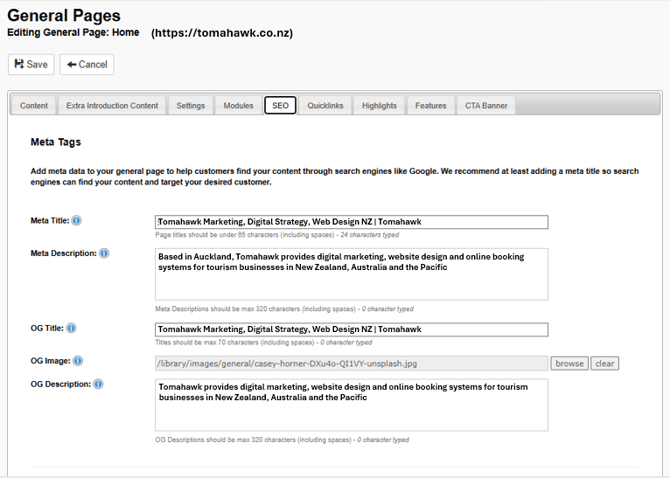
-
Meta Title
This is the title of your Page as it appears in search engine results. It is a free text field and is limited to 65 characters, including spaces. You'll notice at the bottom of the Meta Title field in the CMS that there is a character count to help you keep the text brief.
The naming convention that should be used across all Pages of your website should follow the order of Parent Page | Page Name | Company Name For example a blog post Meta Title would be Blogs | How to Write Content for AI Search | Tomahawk
Make sure to add in any keywords, from keyword research, towards the start so people will see these in the search results.
-
Meta Description
This is a short summary of the details of your Page as it appears in search engine results. It is a free text field and is limited to 320 characters, including spaces. You'll notice at the bottom of the Meta Description field in the CMS that there is a character count to help you keep the text brief.
It should be unique from the introduction field in the Content or Settings tabs for the page you are working on, with best practice to incorporate keywords from keyword research.
Search engines will display this in search results if it is relevant to the query someone has used – but not always - so make it readable, concise, and include your chosen keywords wherever you can.
Remember that when you're filling this out think of the keywords that people will search in order to find your website. Location is always a vital one.
-
OG Title
This is the title of your Page when a link is shared on social media platforms. It is a free text field and is limited to 70 characters, including spaces. You'll notice at the bottom of the OG Title field in the CMS that there is a character count to help you keep the text brief.
-
OG Image
In this field you will select an image which will display when a link is shared to this page on social media platforms such as facebook or LinkedIn.
You may like to use your company logo, or select the same image that you have used in the Hero Banner on this page so that the user is met with the same image when they click through to view the page.
-
OG Description
This is a short summary of the content of your Page when a link is shared on social media platforms such as facebook. It is a free text field and is limited to 320 characters, including spaces. It is a free text field and is limited to 320 characters, including spaces. You'll notice at the bottom of the OG Description field in the CMS that there is a character count to help you keep the text brief.
Search engines will display this in search results if it is relevant to the query someone has used – but not always - so it is recommend to keep it unique (It is recommended to keep this text different from both the Introduction text from the Settings or Content tab, and the Meta Description), concise (under 100 characters), and include your chosen keywords wherever you can.
Remember that when you're filling this out think of the keywords that people will search in order to find your website. Location is always a vital one.
How to add meta data to your website's pages
- Log into the CMS, and navigate to the General section.
- Go into the Pages module
- Select the page that you would like to add the meta-tags to
- Go across the tabs to the SEO tab
- Fill in the Title, Description and Image fields (use lots of keywords!)
The title should be around 60 characters or 3-4 words with keywords first
The description should be around 320 characters - Select Save at the top of the page